
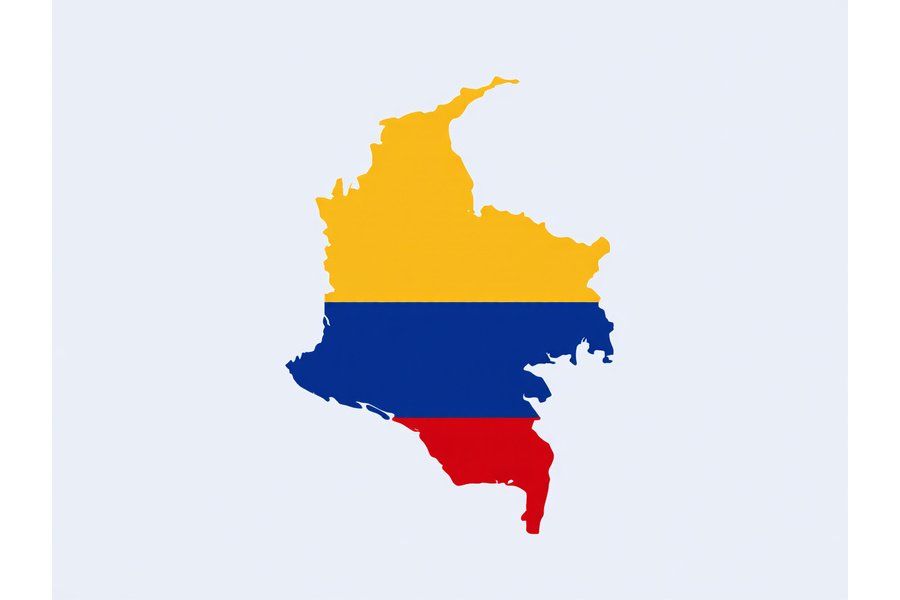
Colombia is a large, diversified emerging market in South America (population ~53 million). It’s rich in natural resources (oil, coal, minerals, coffee), has a sizable services sector (financial services, retail, logistics) and an active manufacturing base (food, cement, chemicals). After a strong rebound from the pandemic, growth has slowed to a more moderate pace: World Bank / official series put 2023 real GDP growth in the mid-single digits (official series and multilateral estimates vary slightly; broadly ~3–4% for 2023) while activity cooled into 2024. Labor markets tightened through 2023 but unemployment remained elevated compared with pre-pandemic norms (national unemployment around ~10–11% in 2023, with informality still a structural challenge). These macro backdrops, commodity prices, FX and domestic politics, are important drivers of M&A appetite and valuation dynamics.
Industries that attract the most M&A interest in Colombia:
- Energy & utilities (oil & gas, power grids, renewable projects) — big privatizations and strategic buyouts.
- Financial services & banking — domestic consolidation and expansion into Central America (regional roll-ups).
- Infrastructure / transport / ports / logistics — strategic assets, attractive to long-term investors.
- Consumer & food (staples, processed foods) — large domestic brands (e.g., Grupo Nutresa) draw both local conglomerates and financial sponsors.
- Cement / construction materials, mining & commodities — cross-border deals and asset sales.
- Tech & software (scaleups) — increasingly active, especially in 2022–2024 (mid-market deals and VC exits).
The Colombian M&A regulatory landscape — how it works and how it differs
Key authorities
- Superintendencia de Industria y Comercio (SIC) — Colombia’s competition authority: it enforces merger-control (pre-merger clearance where thresholds are met) for most sectors. The SIC also enforces anti-competitive conduct and consumer protection.
- Superintendencia Financiera (SFC) — oversees mergers between regulated financial entities (banks, insurers, pension funds); those transactions typically follow the SFC’s supervision and separate rules.
- Other sector regulators (Civil Aviation Authority for airline approvals, energy regulators for network transactions, etc.) may need to sign off depending on industry.
Merger reporting & thresholds (the practical rules)
- Colombia requires mandatory pre-merger notification when the parties individually or jointly exceed threshold levels of operating income or total assets determined annually by the SIC (expressed in Tax Value Units or UVT and converted to COP). Unlike some jurisdictions that focus on transaction value, Colombia looks to the size of the parties (turnover/assets) to trigger filing. The SIC publishes the numeric threshold in a resolution (updated year to year). Failure to notify can produce substantial fines.
The thresholds are lower than the megadeal thresholds used in some larger jurisdictions; for example, SIC thresholds in recent years have been in the range of tens of billions of COP (roughly ~US$15–20 million equivalent in recent resolutions), which brings many mid-market transactions into formal scrutiny. That drives filings even for deals that would be below the “large-deal” bar elsewhere.
How Colombia’s system differs from a few benchmark jurisdictions
- Versus the United States (HSR / DOJ/FTC): the US Hart-Scott-Rodino system uses a two-prong test (transaction value threshold and the “size of person” test) and focuses heavily on transaction value; Colombia focuses on party turnover/assets. Colombia’s thresholds are typically lower in absolute terms, so more mid-market local deals may require notification in Colombia than would in the US.
- Versus the EU: the EU uses community turnover thresholds and concentrates on cross-border dimension within the EU. Colombia’s review is national, faster in many cases, and tailored to domestic competition concerns with heavy discretion by the SIC.
- Versus regional neighbors: Colombia’s regime (Law 1340/2009; SIC implementing resolutions) is broadly similar to other Latin American merger regimes (e.g., Chile, Peru) but notable for: (a) its low de-minimis thresholds, and (b) the SIC’s active posture in enforcement and remedies, especially for sectors deemed strategically important or where consumer impact is clear.
Practical implications for deal teams
- Anticipate a mandatory filing if either party’s turnover/assets are above the SIC threshold, even for small purchase prices. Do not assume “small deal = no filing.”
- Expect the SIC to scrutinize vertical or horizontal overlaps (same value chain, same downstream markets) and the potential impact on consumer prices, access and infrastructure bottlenecks. Remedies tend to be behavioral or structural, and process timing can materially affect deal execution.
Deal tempo — how often transactions are done and why
Volume & value patterns
- Colombia is consistently among the top M&A markets in Latin America by deal count (often 3rd–4th in the region) even when aggregate values fluctuate. The market is characterized by many mid-market transactions (local buyouts, strategic consolidations, private equity), occasional large privatizations or strategic asset sales, and cross-border activity (players from North America, Europe and other LatAm countries). 2022–2024 saw dips and recoveries: aggregate value fell in 2022 vs 2021 but activity has been resilient and rebounded in parts of 2024–2025.
Why deals happen (principal drivers)
- Privatizations / government divestitures — selloffs of state stakes in utilities or energy (Isagen, ISA minority stakes historically) create large one-off transactions.
- Financial consolidation & regional expansion — Colombian banks and financial conglomerates regularly acquire in Central America/Caribbean and consolidate domestically (e.g., Bancolombia’s Panamanian expansion).
- Strategic consolidation in fragmented domestic industries, consumer goods, cement, infrastructure and logistics. Domestic conglomerates and strategic investors seek scale and distribution.
- Private equity and infrastructure funds — Brookfield, Blackstone and other global funds have been active buyers of Colombian energy, power and infrastructure assets.
- Distressed M&A / market exits — airline restructuring (Avianca, Viva), distressed retailers and corporate carve-outs create opportunities for acquisitions or rescues.
Historical M&A activity up to 2023
Colombia’s M&A history mixes state privatizations, banking and financial roll-ups, conglomerate battles and inbound PE/infrastructure transactions. A short chronology of the types of big moments:
- Privatizations & mega asset sales (mid-2010s): sale of the government’s controlling stake in power generator Isagen to Brookfield (2016, ~US$1.99bn) was the largest privatization in a decade and a landmark II.
- Strategic energy consolidation (2021): Ecopetrol’s acquisition of the government’s 51.4% stake in ISA (2021) for roughly COP 14.24 trillion (~US$3.6bn) was a transformational industrial-scale deal reshaping two flagship Colombian companies.
- Banking cross-border roll-outs: Bancolombia’s acquisition of HSBC Bank Panama (Banistmo) in 2013 for ~US$2.1bn is a standard example of Colombian banks using M&A to secure regional reach.
- Corporate control battles: high-profile shareholder fights (e.g., Gilinski’s multi-year pursuit of Grupo Nutresa / Grupo Sura) have reshaped ownership of large food & financial conglomerates and created waves in the public markets.
- Mid-market & tech: through the 2010s and into 2020–2023, many mid-market strategic buyouts and VC-led exits increased, particularly in software/fintech and logistics.
List of Notable Colombian M&A deals
Below is a curated list of notable and/or high-value Colombian deals through 2023 (and a few immediate follow-ons). Privatizations, strategic acquisitions, regional bank deals and big corporate control moves were included below.
- Ecopetrol — acquisition of government’s 51.4% stake in ISA (Interconexión Eléctrica S.A.) — COP 14.236 trillion (~US$3.58bn) (announced Aug 2021; closed Aug 2021).
- Brookfield — acquisition of controlling stake in Isagen (Colombian power generator) — US$1.99bn (January 2016; largest privatization in nearly a decade at the time).
- Bancolombia — acquisition of HSBC Bank (Panama) / Banistmo — ~US$2.1bn (2013). This is one of the largest cross-border purchases by a Colombian bank.
- Cementos Argos — sale of 31% stake in Summit Materials — US$2.875bn (stake sale and combination transactions with Summit — finalized in 2024; this transaction reshaped Argos’ U.S. exposure but is included here as a major corporate move tied to a Colombian corporate).
- Brookfield / BRE — subsequent investments and stake builds in Isagen and renewables — multi-hundred-million / billion-scale investments (continuing 2016–2025 activity; Brookfield remains a large energy investor in Colombia).
- Grupo Aval — acquisition of Megabanco (government/insurer auction) — COP ~808 billion (mid-2000s / 2006–2008 references). It was a major financial consolidation step for Grupo Aval.
- JGDB (Grupo Gilinski) — public offer for Grupo de Inversiones Suramericana (Grupo Sura) — offer valued approx. US$952M–1.19bn (2021 tender/offer and subsequent maneuvers). The Gilinski campaign was a seminal corporate-control saga.
- Jaime Gilinski / Nugil — acquisition campaign and eventual control moves over Grupo Nutresa / related stakes — multi-hundred-million to >US$1bn scale across 2021–2023 processes (control contests, tender offers and negotiated settlements).
- Sale of Colombian government’s minority stakes / asset portfolios (various) — Isagen selldowns and other privatizations aggregated several billion USD in the 2010s. (Isagen sale included above.)
- Viva Air / Avianca consolidation attempt (Avianca’s purchase of Viva’s economic rights; attempted formal merger 2022–2023) — Avianca invested ~US$200M into Viva before the merger attempt failed / was abandoned (complex restructuring/insolvency context). This was a high-profile distressed-asset M&A drama.
- Cementos Argos — coal asset sales (Vale purchase of export coal assets from Argos, ~US$300M — 2009) — an example of commodity-asset deals involving Colombian corporates.
- Brookfield / other infra funds — recurring acquisitions of Colombian power and transmission assets — multiple transactions across the 2010s; Isagen/Brookfield is an anchor example.
- Grupo Aval / Corficolombiana transactions and spin-offs — a number of reorganizations and spin-offs in the financial group over the 2000s–2020s (value varies by transaction).
- Corporate M&A among Colombian food & consumer groups (Nutresa / Sura / Argos share deals) — high-visibility, multi-year battles and tender offers (values vary; see Gilinski/Nutresa context).
- Private equity acquisition of mid-sized utilities and renewables portfolios — frequent across 2015–2023 (many assets sold to international funds).
- Cross-border M&A by Colombian corporates into Central America (Bancolombia, Grupo Aval, Grupo Bolivar movements) — multi-hundred-million to billion deals across the 2010s.
Most recent deals & trends — 2024/2025
- Dealflow in 2024: Colombia closed 2024 with ~161 M&A transactions and aggregate reported value rose year-on-year (driven by a handful of large transactions). The market saw a rebound in value though the number of mid-market deals fluctuated by sector. Cementos Argos / Summit Materials activity was one large headline. Legal and advisory guides (Baker McKenzie, Chambers) recorded a stronger 2024 relative to 2023 because of specific one-off large deals.
- 2025 (early data / H1): TTR and market trackers reported a recovery in H1 2025 with hundreds of transactions and several billion USD in aggregate value. Sectors showing momentum: renewables and energy, tech & software scaleups, logistics and select consumer consolidations. International funds continued to deploy capital in Colombian power and infrastructure assets (Brookfield remained active).
Recent headline examples (2024–early 2025):
- Cementos Argos / Summit Materials combination & sale of Argos stake (Argos sold a 31% stake in Summit Materials for US$2.875bn in a set of transactions that closed in early 2024). That deal materially reshaped Argos’ capital allocation and was a major liquidity event for Colombian shareholders.
- Ongoing asset builds by global funds (Brookfield increasing Isagen exposure; other funds assembling renewable portfolios). These reinforce Colombia as a target for energy & infra capital.
What worked and what didn’t
Success patterns
- Strategic, sector-fit purchases: Acquisitions where the buyer already had operational know-how and local scale (e.g., large utilities bought by strategic/infrastructure investors) tended to integrate smoothly and deliver predictable cash-flows. Brookfield’s Isagen transaction is a canonical example where a long-term infra investor could extract operational and portfolio synergies.
- Regional banking roll-ups with clear cross-selling / footprint benefits: Bancolombia’s Banistmo purchase paid off because it gave the bank a Central American hub and cross-border client base. Expansion with clear strategic rationale (not merely financial engineering) tends to succeed.
- Deals with upfront regulatory planning: Transactions that front-loaded competition/sector approvals and engaged the SIC early avoided surprises. Colombia’s lower thresholds make pre-emptive clearance planning a success factor.
Failures / underperformers (lessons learned)
- M&A into troubled or capital-hungry targets without a credible restructuring plan: Avianca’s attempts to fold Viva into a new group illustrate the peril of buying a distressed competitor without clear capital and operational plans. Avianca poured capital into Viva but later abandoned the formal merger when the insolvency/regulatory path became untenable. That deal created reputational and financial drag.
- Control fights that destroy value through distraction & legal costs: prolonged hostile offers and corporate battles (e.g., drawn-out Gilinski / GEA / Nutresa/Sura tussles) can be value-destructive if they create instability; however, for activists with deep pockets they can succeed in re-orienting corporate strategy if executed cleanly. These battles illustrate that M&A in Colombia is often as much about ownership politics as it is about strategy.
- Underestimating local political/regulatory risk: projects that fail to anticipate public/political resistance (especially in large privatizations or natural-resource deals) face delays, protests or reputational issues. The Isagen privatization and subsequent controversies show the political dimension of large energy deals.
What to expect from Colombian M&A going forward
- Mid-market resilience: Expect steady mid-market activity from strategic consolidations, tech exits and private equity, Colombia’s deal counts keep it among Latin America’s busiest markets by transactions.
- Selective large deals: Large privatizations or corporate rearrangements are sporadic but transformational when they occur (Isagen, ISA, Argos/Summit examples). Investors with patient capital will find long-dated opportunities in energy, renewables and infrastructure.
- Regulation remains a central variable: Because the SIC’s thresholds can sweep in mid-sized deals, deal teams should prioritize regulatory strategy from day-one