
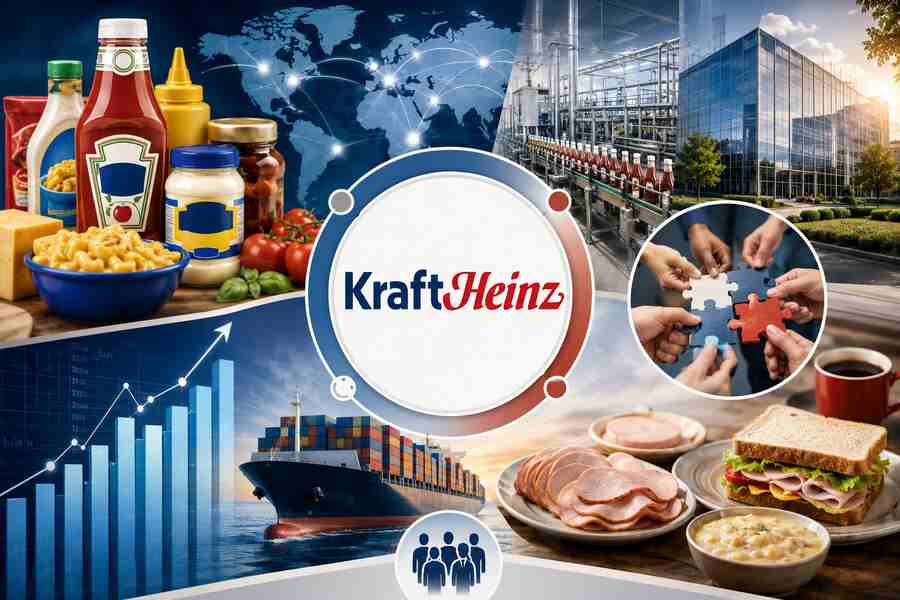
The Kraft Heinz company is one of the world’s largest packaged food and beverage groups, operating across condiments, sauces, cheese, meals, meats, coffee, frozen foods, snacks, infant nutrition and convenience foods. The company was created in 2015 through the merger of Kraft Foods Group and H.J. Heinz, backed by Berkshire Hathaway and 3G Capital.
As of 2025/2026, Kraft Heinz manages a portfolio of more than 200 brands sold in over 190 countries. Major global brands include Heinz, Kraft, Philadelphia, Oscar Mayer, Maxwell House, Lunchables, Capri Sun, Velveeta, Jell‑O, Planters, Grey Poupon and Kool‑Aid.
Key business metrics:
- Approximately 36,000–37,000 employees globally
- 2025 revenue of roughly US$24.9 billion
- Operations across North America, Europe, Latin America, Asia Pacific, Middle East and Africa
- Significant exposure to packaged foods, condiments, refrigerated meals, sauces and grocery staples
- One of the world’s largest condiment and sauces businesses
- Strong global distribution footprint with extensive retail and foodservice channels
- Multi‑billion‑dollar annual operating cash flow generation
- Asset base exceeding US$80 billion during parts of the post‑merger period
The company’s M&A strategy has historically centered around:
- Building scale in packaged foods
- Acquiring iconic consumer brands
- Cost synergies and operational consolidation
- Expanding into higher‑growth international categories
- Portfolio reshaping through divestitures and strategic exits
- Increasing exposure to sauces, condiments and premium convenience products
The Kraft Heinz story is one of the most closely studied consumer goods transactions in modern corporate history because it demonstrates both the power and risks of large‑scale consolidation driven by financial engineering and aggressive cost reduction.
Historical M&A Activity in Chronological Order
StarKist Acquisition (2002)
Heinz acquired the StarKist tuna business from Del Monte Foods for approximately US$1.8 billion. The deal strengthened Heinz’s protein and shelf‑stable food portfolio.
HP Foods Group Acquisition (2005)
Heinz acquired HP Foods Group from Danone for roughly US$855 million. The transaction added iconic UK sauce brands including HP Sauce and Lea & Perrins.
Delimex Acquisition (2006)
Heinz purchased frozen Mexican food company Delimex from Tysons Foods for approximately US$140 million to expand into frozen snacks and Hispanic foods.
Golden Circle Acquisition (2008)
Heinz acquired Australia‑based Golden Circle for around US$300 million, strengthening its position in Asia Pacific and adding juice and canned fruit brands.
Foodstar Acquisition (2010)
Heinz purchased China’s Foodstar, a soy sauce and fermented bean curd producer, for about US$165 million as part of a broader China growth strategy.
Quero Acquisition (2011)
Heinz acquired an 80% stake in Brazilian food company Quero for roughly US$299 million. The acquisition significantly expanded Heinz’s presence in Latin America.
Cerebos Pacific Acquisition (2012)
Heinz acquired Cerebos Pacific in a transaction valued near US$1.3 billion, strengthening its footprint across Asia.
The Transformational Heinz and Kraft Era
Berkshire Hathaway and 3G Capital Acquire Heinz (2013)
One of the most significant food industry buyouts occurred in 2013 when Berkshire Hathaway and 3G Capital acquired H.J. Heinz for approximately US$28 billion including debt.
Strategic rationale:
- Create a platform for global food consolidation
- Apply 3G Capital’s aggressive zero‑based budgeting model
- Improve operating margins
- Generate substantial cost synergies
- Use Heinz as a consolidation vehicle for additional acquisitions
The acquisition dramatically reshaped the consumer-packaged goods landscape and became a defining private‑equity‑style transaction in the food sector.
Kraft Foods Group and Heinz Merger (2015)
In 2015, Heinz merged with Kraft Foods Group in a transaction valued at approximately US$46 billion, creating The Kraft Heinz Company.
This became one of the largest mergers in packaged food industry history.
Strategic reasoning behind the merger:
- Massive cost synergy potential
- Combining leading North American grocery brands
- Greater negotiating power with retailers
- Higher free cash flow generation
- Scale advantages in procurement and manufacturing
- Expanded international distribution opportunities
Expected synergies exceeded US$1.5 billion annually.
Initially, investors praised the transaction because margins improved rapidly under 3G Capital’s cost discipline. However, over time the merger exposed significant structural weaknesses.
Problems that emerged:
- Underinvestment in innovation
- Weak brand modernization
- Excessive focus on cost cutting
- Declining relevance with younger consumers
- Slow adaptation to healthier eating trends
- Heavy dependence on mature grocery categories
The merger later became widely viewed as an example of over‑optimization and excessive cost reduction harming long‑term brand growth.
Major Acquisitions and Investments After the Kraft Heinz Merger
Primal Kitchen Acquisition (2018)
Kraft Heinz acquired paleo and health‑focused condiment brand Primal Kitchen for approximately US$200 million.
Strategic importance:
- Expansion into natural and organic foods
- Access to health‑conscious consumers
- Faster growth categories
- Reduced dependence on legacy processed foods
This acquisition is generally considered successful because Primal Kitchen aligned with evolving consumer preferences.
Ethnic Gourmet Frozen Brands Acquisition (2019)
Kraft Heinz acquired the Ethnic Gourmet frozen business from Ajinomoto to strengthen frozen meals and international cuisine offerings.
Assan Foods Acquisition Agreement (2021)
Kraft Heinz agreed to acquire Turkey‑based Assan Foods from Kibar Holding for roughly US$100 million.
Strategic objectives included:
- Emerging market expansion
- Increased manufacturing capabilities
- Access to Middle Eastern and regional export markets
- Growth in sauces and industrial tomato products
Companhia Hemmer Acquisition (2021)
Kraft Heinz acquired Brazilian condiments company Hemmer for an undisclosed value.
The transaction strengthened Kraft Heinz’s Brazilian condiment business and expanded regional premium sauce offerings.
Just Spices Acquisition (2021)
Kraft Heinz acquired a majority stake in German spice startup Just Spices.
This deal reflected the company’s shift toward:
- Digital‑first food brands
- Direct‑to‑consumer channels
- Premium seasonings
- Younger consumer demographics
Pulmuone Plant‑Based Joint Ventures and Partnerships (2021–2022)
Kraft Heinz pursued strategic investments and collaborations in plant‑based foods to compete with changing consumer dietary trends.
Garcia Carrion Collaboration and Beverage Expansion (2022)
Kraft Heinz expanded strategic beverage partnerships in Europe and international markets as part of its diversification strategy.
Brazilian and Latin American Sauce Portfolio Investments (2022–2023)
Kraft Heinz increased investment activity in high‑growth Latin American condiment categories through tuck‑in brand and manufacturing transactions.
Nature’s Heart Acquisition Expansion Integration (2022)
The company continued integrating plant‑based and wellness beverage capabilities through regional acquisitions and partnerships.
Major Attempted Acquisitions
Unilever Takeover Attempt (2017)
In 2017, Kraft Heinz made an unsolicited US$143 billion bid for Unilever, global consumer goods company.
This would have been one of the largest consumer goods deals ever completed.
Strategic rationale:
- Global diversification beyond packaged foods
- Greater international scale
- Entry into beauty and personal care
- Increased emerging market exposure
- Enhanced purchasing power
Why it failed:
- Strong opposition from Unilever management
- Political concerns in Europe
- Cultural mismatch concerns
- Investor resistance
- Antitrust complexity
The failed bid signaled Kraft Heinz’s ambition to become a global mega‑consolidator.
However, after the rejection, Kraft Heinz largely moved away from transformative mega‑acquisitions.
List of Major Kraft Heinz Related Deals
| Year | Deal | Type | Approximate Value |
| 2002 | StarKist | Acquisition | US$1.8B |
| 2005 | HP Foods Group | Acquisition | US$855M |
| 2006 | Delimex | Acquisition | US$140M |
| 2008 | Golden Circle | Acquisition | US$300M |
| 2010 | Foodstar | Acquisition | US$165M |
| 2011 | Quero | Acquisition | US$299M |
| 2012 | Cerebos Pacific | Acquisition | US$1.3B |
| 2013 | Heinz buyout by Berkshire Hathaway & 3G | Acquisition | US$28B |
| 2014 | Heinz India restructuring investments | Strategic investment | Undisclosed |
| 2015 | Kraft Foods Group merger with Heinz | Merger | US$46B |
| 2015 | Kraft Canada asset integration | Internal consolidation | Undisclosed |
| 2016 | Manufacturing network integrations | Strategic consolidation | Undisclosed |
| 2017 | Unilever takeover attempt | Attempted acquisition | US$143B |
| 2017 | Digital commerce investments | Strategic investment | Undisclosed |
| 2018 | Primal Kitchen | Acquisition | US$200M |
| 2018 | Emerging market supply chain investments | Strategic investment | Undisclosed |
| 2019 | Ethnic Gourmet frozen business | Acquisition | Undisclosed |
| 2020 | E‑commerce and logistics platform investments | Strategic investment | Undisclosed |
| 2021 | Assan Foods | Acquisition | ~US$100M |
| 2021 | Companhia Hemmer | Acquisition | Undisclosed |
| 2021 | Just Spices majority stake | Acquisition | Undisclosed |
| 2021 | Plant‑based partnerships | Strategic investment | Undisclosed |
| 2022 | Latin American condiments expansion deals | Acquisition/investment | Undisclosed |
| 2022 | International manufacturing capacity deals | Strategic investment | Undisclosed |
| 2023 | Food technology and automation investments | Strategic investment | Undisclosed |
| 2023 | Supply chain digitalization partnerships | Strategic investment | Undisclosed |
| 2024 | Portfolio optimization transactions | Strategic restructuring | Undisclosed |
| 2025 | Italian infant food business sale to NewPrinces | Divestiture | Undisclosed |
| 2025 | Planned two‑company separation announcement | Corporate restructuring | Multi‑billion strategic split |
Divestitures and Portfolio Reshaping
Kraft Heinz increasingly shifted from large acquisitions toward portfolio rationalization and divestitures after 2019.
The company recognized that many legacy grocery brands faced structural growth challenges due to changing consumer preferences.
Notable Divestitures and Exits
Planters Sale (2021)
Kraft Heinz sold the Planters nuts business to Hormel Foods for approximately US$3.35 billion.
Why the company sold Planters:
- Focus on core condiment and meal categories
- Generate cash for debt reduction
- Improve portfolio focus
- Exit slower‑growth snack categories
The sale was considered strategically sensible because it strengthened the balance sheet and simplified the portfolio.
Natural Cheese Business Sale (2021)
The company sold portions of its natural cheese business to Lactalis for roughly US$3.2 billion.
Strategic reasoning:
- Reduce leverage
- Streamline manufacturing complexity
- Reallocate capital toward higher‑growth brands
Infant and Specialty Food Business in Italy (2025)
Kraft Heinz agreed to sell its Italian infant and specialty food business to NewPrinces Group.
This transaction reflected the company’s broader strategy of narrowing focus toward stronger global categories and improving portfolio returns.
Potential Oscar Mayer Strategic Review
Reports emerged in 2024–2025 that Kraft Heinz explored strategic alternatives for Oscar Mayer, potentially valuing the business at US$3–5 billion.
This reflected management’s continued effort to separate higher‑growth assets from slower‑growing legacy grocery businesses.
What Worked Well: Successful Strategic Decisions
- Heinz Global Brand Strength
The Heinz ketchup and sauces business remained one of the company’s strongest assets. Heinz maintained substantial global market share leadership and international brand recognition.
The company increasingly prioritized condiments and sauces because:
- Higher margins
- Better pricing power
- Stronger international growth
- Greater innovation potential
- More resilient consumer demand
This strategic focus proved successful.
- Emerging Market Expansion
Acquisitions in Brazil, Turkey and Asia improved Kraft Heinz’s international capabilities.
Emerging markets offered:
- Faster volume growth
- Rising middle‑class consumption
- Better long‑term demographic trends
- Lower dependence on mature North American grocery demand
- Primal Kitchen Acquisition
Primal Kitchen became one of the clearest examples of successful portfolio modernization.
The acquisition aligned with:
- Clean‑label trends
- Health and wellness demand
- Premium pricing opportunities
- Natural ingredients positioning
- Balance Sheet Repair Through Divestitures
After periods of elevated leverage and impairment charges, management used divestitures to strengthen the balance sheet.
This improved:
- Debt metrics
- Financial flexibility
- Capital allocation discipline
- Investor confidence
- Operational Efficiency
Although controversial, 3G Capital’s operating discipline initially produced very large cost savings and margin improvements.
The merger generated billions in efficiencies through:
- Factory consolidation
- Procurement savings
- Workforce reductions
- Zero‑based budgeting
- Supply chain optimization
What Did Not Work
- Over-reliance on Cost Cutting
The biggest criticism of Kraft Heinz involved excessive focus on expense reduction.
Problems included:
- Reduced marketing investment
- Lower R&D spending
- Weak innovation pipelines
- Brand stagnation
- Reduced agility
Competitors investing more aggressively in premiumization and healthier foods outperformed Kraft Heinz in several categories.
- Failure to Anticipate Consumer Shifts
The company remained heavily exposed to processed and packaged grocery staples while consumers increasingly preferred:
- Fresh foods
- Organic products
- Functional nutrition
- Plant‑based alternatives
- Premium and artisanal brands
This reduced long‑term organic growth.
- Massive Brand Write‑Downs
In 2019 Kraft Heinz announced approximately US$15 billion in write‑downs tied largely to Kraft and Oscar Mayer brands.
This became one of the largest warning signs that the merger thesis had weakened.
The write‑downs reflected:
- Overvaluation of legacy brands
- Weak category growth
- Competitive pressures
- Changing consumer preferences
- Unilever Bid Failure
The failed Unilever bid damaged credibility and highlighted strategic overreach.
Investors became increasingly skeptical about the sustainability of mega‑scale consumer consolidation.
- Shareholder Value Destruction
Although the merger initially boosted margins, Kraft Heinz lost substantial market value over the following decade.
Critics argued that:
- Brand equity weakened
- Growth stalled
- Innovation lagged peers
- Debt burdens limited flexibility
- Cost cutting became excessive
The merger is frequently cited as an example of how aggressive financial engineering alone cannot sustain consumer brands long term.
Strategic Evolution After 2020
After several difficult years, Kraft Heinz shifted strategy significantly.
Management began focusing on:
- Brand reinvestment
- Product innovation
- Digital commerce
- International growth
- Health and wellness products
- Supply chain modernization
- Premium condiments and sauces
- Data and automation investments
The company also became more selective with acquisitions, preferring:
- Smaller bolt‑on acquisitions
- High‑growth niche brands
- International condiment businesses
- Digital‑native food brands
This represented a major departure from the earlier large‑scale consolidation approach.
Recent M&A and Strategic Updates (2025–2026)
In 2025 and 2026 Kraft Heinz entered a major strategic transition period.
The company announced plans to separate into two independent businesses, effectively unwinding portions of the original Kraft Heinz merger structure.
The proposed separation aimed to create:
- A faster‑growing global sauces, condiments and taste‑elevation business
- A North American grocery business focused on traditional packaged foods
Strategic reasoning behind the separation:
- Sharper management focus
- Better capital allocation
- Improved investor transparency
- Different growth profiles for each business
- Greater agility
- Potential valuation uplift
However, in early 2026 new leadership paused aspects of the breakup strategy while pursuing a large operational turnaround initiative.
Key 2025–2026 developments included:
- A planned US$600 million reinvestment program into marketing, R&D and sales capabilities
- Increased focus on restoring U.S. market share
- Greater investment in innovation and product quality
- Expanded focus on sauces and condiments
- Portfolio simplification
- Continued evaluation of strategic divestitures and acquisitions
- Emphasis on profitable volume growth rather than pure margin expansion
Management acknowledged that prior years of underinvestment contributed to slower growth and weaker competitiveness.
The company’s newer strategy reflects a broader industry realization that consumer packaged goods companies must balance efficiency with sustained brand investment and innovation.
Final Thoughts
Kraft Heinz’s M&A history represents one of the most important case studies in modern consumer goods strategy.
The company achieved enormous scale and generated substantial cost synergies through consolidation. However, several strategic assumptions ultimately proved flawed.
Successful elements:
- Building a dominant global condiment franchise
- International expansion
- Strong cash flow generation
- Efficient operations
- Portfolio optimization through selective divestitures
- Acquiring health-oriented brands like Primal Kitchen
Less successful elements:
- Excessive cost cutting
- Weak innovation investment
- Overdependence on mature grocery categories
- Failure to modernize legacy brands quickly enough
- Destruction of shareholder value after the merger peak
The company’s future increasingly depends on:
- Rebuilding brand equity
- Innovation execution
- International growth
- Premium Products
- Health and wellness positioning
- Effective portfolio management
- Balancing operational discipline with sustainable long-term growth
Kraft Heinz’s evolution from mega-merger champion to portfolio restructuring case study illustrates how consumer behavior, innovation and brand relevance ultimately matter more than scale alone in the global food industry.
Today, the company is attempting to reposition itself from a mature packaged-food conglomerate into a more agile, innovation-driven global food platform. Management’s renewed emphasis on sauces, condiments, premium convenience foods and international expansion reflects a strategic pivot toward categories with stronger pricing power and higher long-term growth potential.
The next phase of Kraft Heinz’s M&A strategy will likely involve:
- Smaller bolt-on acquisitions rather than transformational mega-mergers
- Increased investment into health-conscious and functional food brands
- Expansion in emerging markets with rising middle-class consumption
- Continued divestiture of slower-growth legacy assets
- Supply-chain and technology modernization investments
- Greater use of digital commerce and data-driven consumer insights
Industry analysts increasingly view Kraft Heinz as a company in transition rather than decline. While many of the original assumptions behind the 2015 Kraft-Heinz merger proved overly optimistic, the company still controls some of the most valuable food brands in the world and retains enormous distribution scale.
Whether Kraft Heinz ultimately succeeds will depend on its ability to balance operational efficiency with long-term brand building, a lesson that has become central to the broader consumer packaged goods industry.