
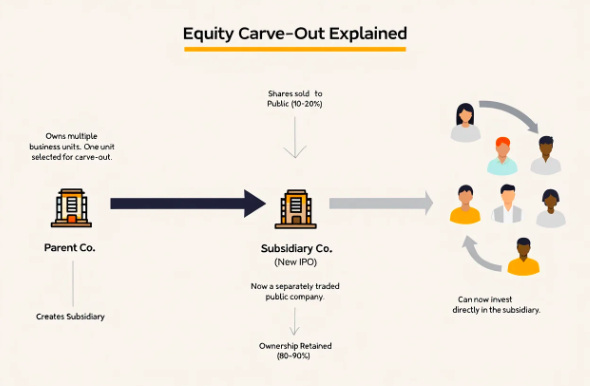
An Equity Carve-Out (ECO) is a form of corporate restructuring in which a parent company creates a new, publicly traded company by offering shares of a subsidiary to the public through an Initial Public Offering (IPO). In most cases, the parent retains a controlling or significant minority interest in the new company.
This differs from a full divestiture, where the parent sells 100% of its interest. In an equity carve-out, the parent both raises capital and unlocks value while maintaining a stake in the business.
Context in Mergers and Acquisitions (M&A)
In the world of Mergers and Acquisitions, companies are often looking for ways to maximize shareholder value, raise capital, or streamline their operations. An equity carve-out is one such strategic tool.
Carve-outs are used when a company decides that one of its divisions or subsidiaries has potential that is not fully appreciated under the umbrella of the parent company. By listing this business independently, the firm seeks to:
- Highlight the subsidiary’s financials and potential
- Create a separate entity with a focused strategic direction
- Raise capital for the parent or subsidiary
- Provide a clearer picture to investors of the unit’s standalone performance
Key Characteristics of Equity Carve-Outs
- Partial Sale via IPO: Only a portion (often 10%–20%) of the subsidiary’s equity is sold to the public. The parent keeps the rest.
- New Public Company: The subsidiary gains a separate board, financial statements, and governance structure.
- Capital Raising: The IPO generates cash—either for the parent, the subsidiary, or both.
- Strategic Control: The parent typically retains management influence or strategic oversight through its remaining ownership.
Comparison to Related Concepts
- Spin-off: Unlike a carve-out, a spin-off involves distributing shares of a subsidiary directly to existing shareholders without raising cash through a public offering.
- Divestiture: This involves selling the entire subsidiary, usually to another company, not through an IPO.
Why Companies Use Equity Carve-Outs
- Unlock Hidden Value: Some subsidiaries are “hidden gems” whose value is not fully reflected in the parent company’s stock.
- Strategic Focus: It allows each entity (parent and carved-out firm) to focus on its own core competencies.
- Raise Funds Without Losing Control: It brings in capital while allowing the parent to retain majority ownership and control.
- Step Toward Full Divestiture: Sometimes, a carve-out is a first step toward eventually selling the rest of the stake.
Real-World Examples
1. GM and Delphi Automotive (1999)
General Motors executed a carve-out of its auto parts unit, Delphi Automotive, through an IPO. GM initially retained a majority stake but later fully divested. This allowed Delphi to operate independently and eventually become a leading supplier in the auto parts industry.
2. Pfizer and Zoetis (2013)
Pfizer, a pharmaceutical giant, carved out its animal health division, Zoetis, via an IPO. Initially, Pfizer retained around 80% of Zoetis, but it fully exited within two years. This allowed Zoetis to focus exclusively on animal health, and the carve-out unlocked significant shareholder value.
3. DuPont and Chemours (2015)
Although technically closer to a spin-off, DuPont’s restructuring into Chemours, which handled DuPont’s performance chemicals business, followed a carve-out-like process. It shows how businesses segment themselves to streamline operations and focus on distinct strategic goals.
Risks and Challenges
- Market Reception: The success of the IPO depends on investor confidence in the subsidiary’s standalone value.
- Governance Complexity: Managing the relationship between the parent and the carved-out firm can be complicated.
- Regulatory and Disclosure Burden: A new public company must meet all SEC filing requirements and corporate governance norms.
Conclusion
An Equity Carve-Out is a valuable corporate tool that serves multiple strategic purposes, capital raising, value realization, and operational clarity, without requiring a full divestiture. It provides investors with a more transparent view of different business units, often leading to improved valuations for both the parent and the carved-out entity.
In the realm of M&A strategy, understanding carve-outs is essential for evaluating corporate restructuring moves, shareholder value creation, and capital market dynamics.