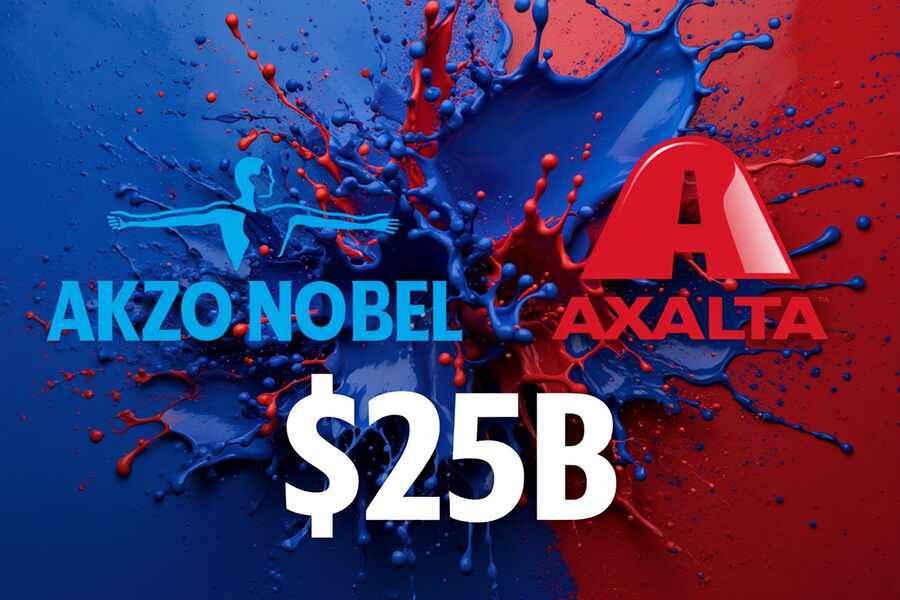
On 18 November 2025, AkzoNobel N.V. (“AkzoNobel”) and Axalta Coating Systems Ltd. (“Axalta”) announced they have executed a definitive agreement to combine in an all-stock merger of equals, thereby creating a premier global coatings company.
- The transaction implies an enterprise value of approximately US$ 25 billion and builds on about US$ 17 billion of combined revenues.
- Shareholders of AkzoNobel will own ~55 % of the combined entity; Axalta shareholders ~45 %.
- Axalta shareholders will receive 0.6539 ordinary shares of AkzoNobel for each share of Axalta.
- AkzoNobel will pay a special cash dividend of about €2.5 billion to its shareholders as part of the deal.
- The new company will be dual-headquartered in Amsterdam (Netherlands) and Philadelphia (USA), initially dual-listed on Euronext Amsterdam and the New York Stock Exchange, and ultimately move to a single NYSE listing.
- Closing is anticipated “late 2026 to early 2027”, subject to regulatory approvals, shareholder votes and other customary conditions.
The Companies Involved
AkzoNobel
Founded in the Netherlands, AkzoNobel is a global paints and coatings company known for brands such as Dulux, International, Sikkens and Interpon.
- It operates in more than 150 countries and emphasizes innovation, sustainability and delivering coatings solutions across decorative, industrial and protective sectors.
- The company has undergone transformation and cost-focus in recent years, disposing of non-core assets and restructuring to drive efficiency.
Axalta Coating Systems
Axalta is a global leader in coatings and application systems, headquartered in Philadelphia, U.S. It serves light vehicle, commercial vehicle, industrial, refinish and architectural/marine markets.
- With more than 100,000 customers in over 140 countries, Axalta brings deep expertise in mobility coatings (auto body repair & OEM), industrial coatings and powder systems.
- It has roots stretching back over 150 years in coatings, and its portfolio is seen as high-profitability and strong growth-oriented.
Strategic Rationale
From an M&A advisory vantage point, the deal offers a number of clear strategic and financial benefits:
- Complementary portfolios & end markets: The combination brings together AkzoNobel’s strengths in decorative, protective, powder and industrial coatings with Axalta’s mobility/refinish and industrial coatings business. This broadens the product set and customer base globally.
- Geographic expansion and scale: The merged company will operate in ~160+ countries with ~173 manufacturing sites and ~91 R&D centres per the release, enhancing global reach and local customer service.
- Innovation and R&D synergies: With combined research capability (approximately US$400 million annual R&D spend, some 4,200 researchers, 3,200 patent filings) the merged entity aims to accelerate development of advanced coatings solutions.
- Cost and operational synergies: The companies estimate about US$600 million of identified run-rate cost synergies, with 90 % expected to be achieved within the first three years post-close.
- Financial profile improvement: Post-deal pro-forma figures show revenues of roughly US$17 billion, adjusted EBITDA of US$3.3 billion, and adjusted free cash flow of US$1.5 billion. Net leverage targeted at 2.0-2.5× and maintaining an investment-grade credit rating.
- Competitive positioning: The merged entity will become one of the largest coatings companies globally, positioning itself to better compete with major players such as PPG Industries and Sherwin‑Williams.
Deal Structure & Governance
Key governance/structural attributes:
- Merger structured as a “merger of equals” though AkzoNobel takes the CEO role (Greg Poux-Guillaume) and Axalta’s Chair (Rakesh Sachdev) becomes Chair of the combined Board.
- Board composition: 11 directors (4 from each company, 3 independent). Dual HQ and initial dual listing, then single NYSE listing.
- Share exchange: Axalta shareholders receive 0.6539 AkzoNobel shares each. AkzoNobel issues stock and will pay its shareholders a special dividend of €2.5 billion.
- Both companies’ boards unanimously approved the agreement.
Risks & Considerations
While the strategic logic is sound, several risk factors and integration challenges warrant attention:
- Execution risk: Realising the identified US$600 million in cost synergies within three years is ambitious. Historically, M&A integration often under-delivers.
- Regulatory & competition risk: Given the size and global footprint, antitrust / competition regulators may impose conditions, which could delay or limit the transaction.
- Cultural integration and operational complexity: Merging two large global organisations with thousands of employees, R&D centres and manufacturing sites across geographies is non-trivial.
- Market & cyclicality risk: The coatings industry is exposed to macro-economic swings (construction, automotive, industrial end-markets), which may impact revenue/cash flow forecasts.
- Valuation and shareholder reaction: Although the deal is pitched as a merger of equals, AkzoNobel clearly gains control. Market reaction has been tepid—some investors may question the premium or strategic upside.
Implications for Stakeholders
- For shareholders: AkzoNobel shareholders benefit from the special dividend and future upside of the combined entity; Axalta shareholders gain exposure to a larger global platform and potentially stronger profitability.
- For customers: With a broader product portfolio, stronger global footprint and enhanced R&D capability, customers may benefit from innovation, scale and integrated solutions.
- For competitors: The enlarged entity will put pressure on other major coatings players in terms of scale and geographic reach, potentially increasing consolidation in the industry.
- For the industry: This transaction signals renewed M&A momentum in the coatings/chemicals sector — even in cyclical end-markets, players are pursuing scale and global reach.
Outlook
Assuming the transaction closes in late 2026 or early 2027 as planned, the next 12-24 months will be critical in the following areas:
- Regulatory clearance: Watch for antitrust decisions in key jurisdictions (EU, US, China, etc).
- Integration planning and execution: The companies must lock in operational plans for site rationalisation, systems integration, R&D alignment and culture unification.
- Realisation of synergies: Monitoring cost savings, margin improvement and cash-flow generation is key.
- Debt/leverage management: Achieving targeted net leverage of ~2–2.5× will be essential to maintaining credit ratings and financial flexibility.
- Market response and management of investor expectations: Given the scale and ambition, managing communication, execution risks and growth delivery will matter for shareholder confidence.
In sum, this is a landmark deal in the global coatings market. For both AkzoNobel and Axalta, the combination represents an opportunity to leap-frog scale, expand global reach and accelerate innovation. The strategic rationale is clear, but the real value will be unlocked in the coming years through execution, integration, and delivering the promised synergies.