
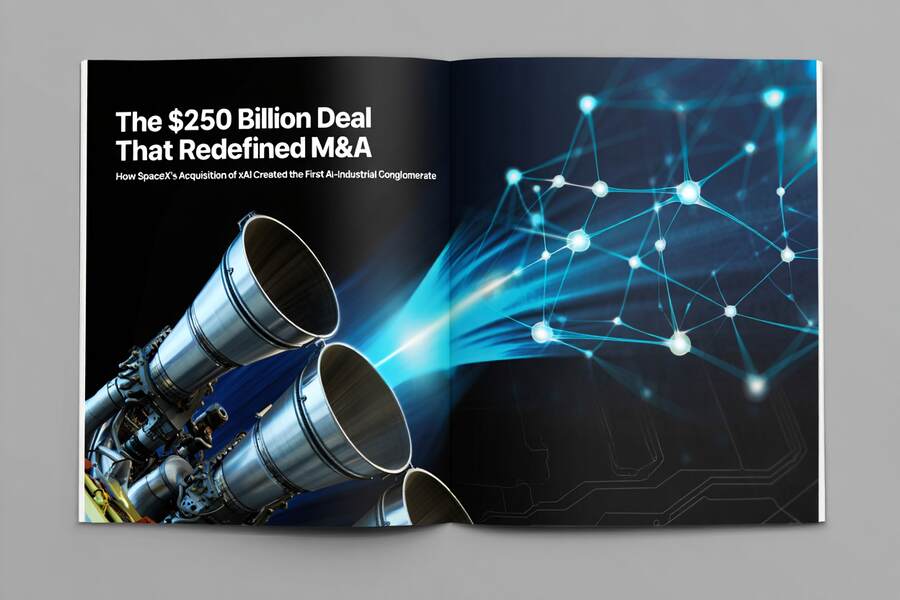
How SpaceX’s Acquisition of xAI Created the First AI-Industrial Conglomerate
In February 2026, Elon Musk orchestrated what may become one of the defining mergers of the decade: SpaceX’s acquisition of xAI in an all-stock transaction that valued xAI at approximately $250 billion and the combined entity at roughly $1.25 trillion.
The deal was extraordinary not only because of its scale, but because it fundamentally challenged traditional assumptions about mergers and acquisitions. This was not a conventional consolidation designed to eliminate competition, cut costs, or expand market share in a mature industry. Instead, it represented the fusion of artificial intelligence, aerospace infrastructure, satellite communications, autonomous systems, and data distribution into a single vertically integrated ecosystem.
For many observers, the transaction marked the moment when AI ceased to be “just software” and became strategic infrastructure.
The Companies Behind the Deal
SpaceX
Founded in 2002 by Elon Musk, SpaceX transformed the global aerospace industry by dramatically lowering launch costs through reusable rockets. Over two decades, the company evolved from a commercial launch provider into a strategic infrastructure platform spanning launch systems, satellite internet, defense-adjacent capabilities, and global communications.
Its Starlink business became particularly important. Originally conceived as a satellite broadband network, Starlink evolved into one of the world’s largest space-based communications systems, providing global internet connectivity and increasingly serving governments, militaries, enterprises, and remote regions.
By 2026, SpaceX was no longer simply a rocket company. It had become a hybrid of aerospace contractor, telecommunications provider, and strategic infrastructure operator.
xAI
Launched in 2023, xAI was Elon Musk’s response to the accelerating AI race dominated by OpenAI, Google DeepMind, Anthropic, and others. The company’s flagship product, Grok, positioned itself as an alternative large language model integrated deeply with real-time information flows and the X platform.
Unlike many AI startups focused solely on model development, xAI pursued aggressive infrastructure expansion. The company invested heavily in GPU clusters, data center capacity, and vertically integrated compute systems. Its ambition extended beyond chatbot products toward foundational AI infrastructure.
However, like many frontier AI companies, xAI required enormous amounts of capital. Advanced AI training increasingly depended on access to compute power, energy, cooling systems, proprietary data, and long-term financing capacity.
That reality made the SpaceX combination strategically compelling.
The Deal Announcement — February 2026
When the transaction was announced in February 2026, many initially interpreted it as another Musk ecosystem restructuring.
But the market soon realized this was something much larger.
Unlike traditional mergers focused on eliminating competitors or consolidating market share, the SpaceX-xAI combination centered on infrastructure convergence:
- AI model development
- satellite communications
- launch systems
- global connectivity
- compute infrastructure
- autonomous technologies
- data distribution
The strategic thesis was increasingly clear: the future AI winners may not simply be companies with the best models, but companies that control the entire infrastructure stack behind intelligence.
That includes:
- compute
- connectivity
- distribution
- energy access
- hardware deployment
- logistics
- proprietary data systems
This was not software acquiring software.
It was infrastructure acquiring intelligence.
What Actually Happened in May 2026
The real significance of the merger became fully visible in May 2026.
While the acquisition itself occurred in February, May was the month when investors, regulators, and the broader technology industry began to understand what the transaction actually represented.
xAI Stopped Functioning as a Standalone Company
By May 2026, xAI was being operationally integrated into SpaceX under what reports described as “SpaceXAI.”
This was not merely a financial combination or holding-company structure. Teams, infrastructure, leadership, and operations were being consolidated directly into the broader SpaceX ecosystem.
The integration reportedly included:
- Grok AI systems
- X platform infrastructure
- AI compute operations
- satellite-enabled communications systems
- autonomous technology initiatives
That operational shift transformed perceptions of the transaction from a large private-market acquisition into a genuine industrial consolidation.
The AI Infrastructure Strategy Became Clear
May 2026 also revealed the broader strategic logic behind the merger.
SpaceX’s reported IPO materials and industry analysis increasingly framed the transaction around:
- orbital AI infrastructure
- space-based compute systems
- satellite-enabled AI distribution
- vertically integrated communications and intelligence systems
The argument was that terrestrial AI infrastructure may eventually face severe constraints involving:
- electricity consumption
- cooling requirements
- data center scalability
- compute concentration
SpaceX positioned itself as one of the few companies capable of integrating communications infrastructure, launch systems, satellite networks, and AI compute into a unified architecture.
That is why analysts increasingly described the combined entity as:
- “the first AI-industrial conglomerate”
- “AI plus aerospace convergence”
- “the vertically integrated AI stack”
SpaceX Prepared for a Historic IPO
Reports throughout May 2026 indicated that SpaceX was preparing for a potential IPO that could value the company between $1.5 trillion and $1.75 trillion.
Those disclosures reportedly highlighted:
- massive AI infrastructure spending
- escalating GPU and compute costs
- expansion of AI data center capacity
- long-term investments in AI hardware systems
The filings also made clear that AI was no longer a side initiative within the Musk ecosystem. It had become central to SpaceX’s future strategy.
Restructuring and Leadership Changes
The integration process also involved significant restructuring.
Reports indicated:
- layoffs within xAI
- consolidation of engineering teams
- departures of several co-founders
- greater operational oversight from SpaceX leadership
Executives associated with Starlink and SpaceX infrastructure operations increasingly took control over the combined AI division.
That shift reinforced the idea that the merger was transitioning xAI away from a startup-style AI lab toward a large-scale infrastructure organization.
Why This Deal Was Different
The SpaceX-xAI transaction broke almost every conventional M&A framework.
Historically, mega-mergers have centered around:
- horizontal consolidation
- market share expansion
- cost synergies
- distribution advantages
- financial engineering
This deal represented something fundamentally different:
the convergence of intelligence infrastructure and industrial systems.
The combination unified:
- AI model development
- launch infrastructure
- satellite networks
- global communications
- autonomous systems
- large-scale compute
- data distribution
In many ways, it represented the emergence of a new category of company:
the AI-industrial conglomerate.
The Rise of Vertical AI Infrastructure
The defining strategic insight behind the transaction was that artificial intelligence is becoming increasingly constrained by physical infrastructure.
Training frontier AI systems requires:
- enormous power consumption
- advanced cooling systems
- semiconductor access
- high-bandwidth communications
- global compute distribution
- massive capital expenditure
Most AI firms remain dependent on external providers for these capabilities:
- cloud hyperscalers
- telecom operators
- semiconductor manufacturers
- data center operators
SpaceX offered a radically different model.
Through Starlink and its launch operations, SpaceX already controlled large-scale communications infrastructure and access to orbital deployment capabilities. Musk also publicly discussed ambitions involving space-based data centers and orbital compute systems — concepts that, while highly ambitious, aligned with the company’s broader infrastructure strategy.
The merger therefore represented an attempt to internalize multiple layers of the AI value chain under one corporate structure.
Why Wall Street and Silicon Valley Took Notice
The transaction resonated across capital markets and the technology industry because it reflected several structural shifts occurring simultaneously.
-
Private Markets Are Replacing Traditional Public M&A
Many of the largest strategic transactions are no longer occurring between mature public corporations. Instead, they are increasingly happening inside tightly controlled private ecosystems with concentrated founder influence and access to enormous private capital pools.
The SpaceX-xAI merger demonstrated how founder-led private companies can execute transformative combinations outside the constraints traditionally associated with public-company mergers.
-
AI Is Becoming an Infrastructure Industry
For years, AI was viewed primarily as a software category.
This deal reinforced the idea that AI increasingly resembles strategic infrastructure:
- capital intensive
- energy intensive
- geopolitically sensitive
- integrated with communications and defense systems
That changes how investors evaluate AI companies and how governments regulate them.
-
Industry Boundaries Are Disappearing
The merger blurred the distinctions between:
- aerospace
- telecommunications
- artificial intelligence
- robotics
- cloud infrastructure
- defense-adjacent technology
This convergence may become one of the defining corporate trends of the next decade.
The “Musk Ecosystem” Strategy
The merger also formalized something investors had increasingly recognized for years: Elon Musk’s companies function less like independent businesses and more like interconnected components of a broader industrial ecosystem.
The combined structure connected:
- SpaceX
- Starlink
- xAI
- Grok
- X
- autonomous systems
- communications infrastructure
- real-time data networks
The result was an unusually integrated architecture combining:
- AI models
- proprietary distribution
- satellite connectivity
- launch infrastructure
- data generation
- autonomous technologies
Few modern technology conglomerates possess that level of vertical integration.
Regulatory and Geopolitical Implications
The merger also raised complex regulatory questions.
Unlike traditional antitrust cases focused on market concentration within a single industry, the SpaceX-xAI combination touched multiple strategically sensitive sectors simultaneously:
- AI infrastructure
- communications networks
- satellite systems
- defense-adjacent technologies
- global internet access
Governments increasingly view AI and communications infrastructure as matters of national security. Future scrutiny may therefore focus less on pricing power and more on strategic control over critical technological systems.
The deal also intensified broader geopolitical debates around:
- sovereign AI capabilities
- infrastructure independence
- satellite dominance
- military applications of AI
- private-sector influence over strategic technologies
In many ways, the transaction foreshadowed a future where the world’s most important technology companies are evaluated not merely as businesses, but as geopolitical actors.
Why This May Become the Defining M&A Story of the Decade
The SpaceX-xAI transaction mattered because it represented far more than a large acquisition.
It signaled a structural shift in how investors, founders, and governments think about artificial intelligence.
The old technology model separated:
- software
- infrastructure
- communications
- hardware
- logistics
This merger attempted to unify them.
Whether the strategy ultimately succeeds remains uncertain. The combined company faces enormous execution risks, massive capital requirements, regulatory scrutiny, and intense competition across multiple industries.
But strategically, the transaction already changed the conversation.
It suggested that the future winners in AI may not be standalone model developers. Instead, they may be vertically integrated ecosystems capable of controlling compute, connectivity, distribution, infrastructure, and autonomous systems simultaneously.
That is why the SpaceX-xAI merger may ultimately be remembered not simply as one of the largest private-market deals ever attempted, but as the transaction that redefined what M&A means in the age of artificial intelligence.